
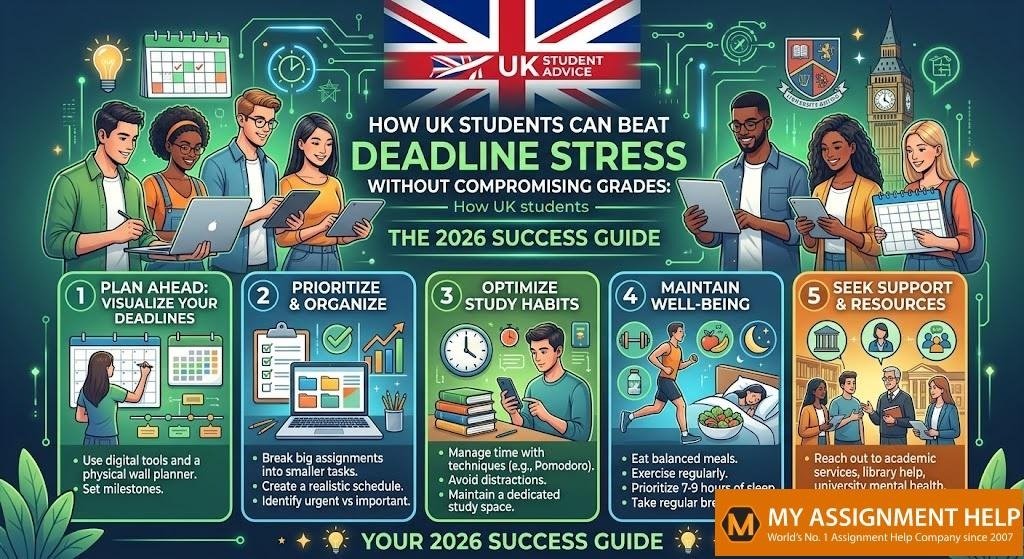

In today’s high-pressure academic landscape, deadline stress has evolved from a seasonal nuisance to a year-round challenge. For students across the UK—from Year 11s tackling their first GCSE mocks to final-year university students staring down a 10,000-word dissertation—the weight of expectations can be paralyzing.
As we navigate the 2026-2027 academic cycle, the digital demands on students have never been higher. However, beating deadline stress isn’t about working longer hours; it’s about strategic efficiency. By integrating evidence-based productivity methods with the right help with assignment you can maintain top-tier grades without sacrificing your mental well-being.
The Anatomy of Deadline Stress in the UK
In the United Kingdom, academic stress is often tied to “clustering”—where multiple modules or subjects have submission dates within the same 48-hour window. This is particularly prevalent during the January assessment period and the May/June exam season.
Common triggers include:
- The UCAS & Personal Statement Crunch: Balancing university applications with A-Level coursework.
- Ambiguous Grading Rubrics: Not knowing exactly how to “unlock” the higher marks.
- The Procrastination Loop: Avoiding a task because it feels too large, which in turn makes the task more stressful as the clock ticks down.
1. Master the ‘Backward Planning’ Method
Standard time management often fails because it looks forward from today. Instead, use Backward Planning. Start with your submission date on the UCAS portal or Turnitin and work backward to create “milestone deadlines.”
The 3-Step Milestone Strategy:
- Drafting Deadline: Finish a rough “skeleton” 7 days before the due date.
- Review & Polish: Dedicated 48 hours for proofreading and referencing.
- Buffer Day: A “no-work” day to account for technical glitches or library closures.
2. Prioritise Using the UK Academic Weighted Matrix
Not all assignments are created equal. A weekly lab report worth 5% of your module should not receive the same emotional or temporal investment as a final essay worth 60%. When the workload becomes mathematically impossible to manage alone, many students choose to pay someone to do assignment tasks that carry lower weight, allowing them to focus their “Golden Hours” on high-stakes summative assessments.
| Assignment Type | Priority Level | Strategy |
| Summative (High Weight) | Critical | Allocate your “Golden Hours” (peak energy times). |
| Formative (Feedback Only) | Medium | Focus on experimenting with new ideas; don’t aim for perfection. |
| Weekly Tasks/Quizzes | Low | Use the Pomodoro Technique to finish these in focused bursts. |
3. Leverage “Action Triggers” to Combat Procrastination
Procrastination is rarely about laziness; it’s usually anxiety-based avoidance. To break this, use “Action Triggers”—pre-decided cues that remove the need for willpower. Decisions made in advance reduce the cognitive load of starting.
4. Ethical AI Integration: The 2026 Advantage
In 2026, the “smart student” knows how to use AI as a co-pilot, not a ghostwriter. Use Large Language Models (LLMs) to:
- Generate Outlines: Break a complex prompt into logical headings.
- Simplify Concepts: Ask AI to explain a complex theory in simple terms.
- Check for Logic Gaps: Use AI to find counter-arguments you may have missed.
5. Create a ‘Deep Work’ Sanctuary
The UK student environment is often distracting. Whether it’s a noisy shared flat or a busy city library, Deep Work involves working in a state of distraction-free concentration.
- Digital Hygiene: Use apps to block social media during study sessions.
- The “Study-Only” Zone: Train your brain to associate a specific desk with work.
6. Understanding the “Assignment Brief”
Many marks are lost because students answer the question they wanted to be asked, rather than the one on the paper.
- Analyze the Verbs: Does the brief ask you to Describe, Analyze, or Evaluate?
- The Marking Criteria: Always keep the rubric open. If it asks for “wide reading,” ensure your bibliography reflects diverse sources.
7. Utilize Professional Academic Support Wisely
There is a common misconception that seeking help is a sign of weakness. In reality, high-performing professionals in every field use consultants. For students, platforms like MyAssignmentHelp.com offer a vital safety net.
These services provide:
- Structural Guidance: Understanding how a high-distinction essay is formatted.
- Subject Expertise: Gaining clarity on technical subjects that a classroom setting might not fully cover.
- Sample Papers: Using professionally written samples to bridge the gap between theory and application.
By using reliable academic support services as a learning tool, you can significantly reduce the “blank page syndrome” that causes so much deadline anxiety.
8. The Science of Active Recall vs. Passive Reading
Re-reading your notes is the least effective way to study. It creates an “illusion of competence.” Instead, use Active Recall.
- The Blurting Method: Read a page, close the book, and write down everything you remember.
- Spaced Repetition: Review your assignment notes 1, 3, and 7 days after writing them.
9. Maintain a “Fuelled” Mind: The Physical Connection
A brain running on 4 hours of sleep cannot produce high-quality work.
- The 90-Minute Cycle: Human focus wanes after 90 minutes. Take a 15-minute walk; fresh air and “optic flow” lower cortisol levels.
- Hydration: Even mild dehydration can drop your concentration by 20%.
10. Navigating the 2026 UK Assessment Landscape
The shift toward “authentic assessment” in UK universities means more real-world projects and fewer traditional exams.
- Portfolio Building: If your assignment involves a portfolio, start documenting your process from day one.
- Peer Collaboration: Form a “study syndicate.” Explaining a concept to a classmate is the best way to master it yourself.
11. Managing the “Final 48 Hours”
When the deadline is looming, panic is your biggest enemy.
- Stop New Research: 48 hours before, you have enough info. Start refining.
- Read Out Loud: This is the fastest way to find grammatical errors.
- Check Your Citations: Ensure your Harvard or OSCOLA referencing is flawless.
12. Learning from the Feedback Loop
Once the stress has passed, don’t just look at the grade. The feedback is your roadmap. If it says “lack of critical analysis,” focus your next session on weighing different academic perspectives.
Final Thoughts: Turning Stress into Strength
Deadline stress is an inevitable part of the UK academic experience, but it doesn’t have to be a destructive one. Success in 2026 is defined by balance. Work hard, but work smart—and never be afraid to reach out for the expert guidance that can help you cross the finish line with confidence.
Frequently Asked Questions
Q.1 What is the “Backward Planning” method for UK assignments?
Backward Planning involves starting from your submission date (e.g., your Turnitin or UCAS deadline) and working in reverse to set internal milestones. Instead of wondering what to do today, you schedule your “Buffer Day,” “Review & Polish” phase, and “Drafting Deadline” first, ensuring you never run out of time for final checks.
Q.2 How do I handle multiple deadlines falling in the same week?
Use the UK Academic Weighted Matrix. Categorize your assignments by their percentage of your total module grade. High-weight “Summative” tasks should get your peak energy hours, while low-weight weekly tasks or “Formative” feedback-only assignments should be completed in focused, timed bursts to prevent them from draining your energy.
Q.3 Why do I feel paralyzed by large assignments like dissertations?
This is often the “Procrastination Loop,” where the size of a task triggers anxiety-based avoidance. To break it, use Action Triggers—pre-determined cues like “When I boil the kettle, I will outline one paragraph.” This removes the need for willpower and lowers the cognitive barrier to starting.